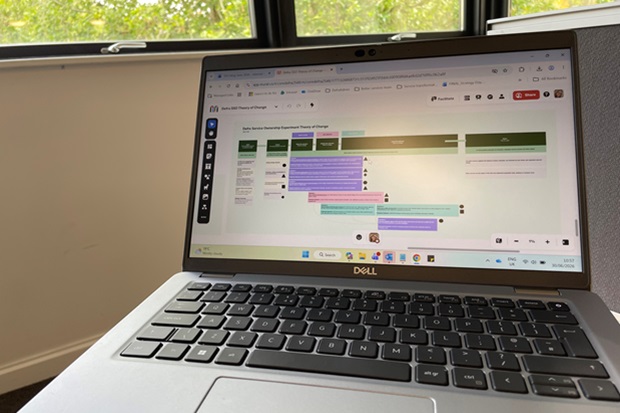
My service transformation team at Defra has been grappling for a while with how we can support better, more efficient, user-focused services. How Defra’s structured and operates makes effective service delivery hard. And services are how our policies turn into outcomes for citizens. They are our bread and butter.
The team has done sterling work mapping our service landscape and creating a taxonomy, to build a shared understanding of services and a shared language for describing them. And they’d got the ball rolling on service ownership before I joined.
What is it
Across government, teams are experimenting with senior (or single) service ownership. DWP, HMRC, the Home Office and the NHS have all moved in this direction. What this means is a single, senior point of accountability, throughout the end-to-end service journey (through policy, delivery and operations, across all channels).
A Public Accounts Committee report recommended that: “departments put in place a single director-level owner for each service, with accountability for its end-to-end operation and decision-making authority...”. And we committed to “greater service ownership, upskilling and empowerment of service owners across Defra group” in our Digital and Data Strategy.
Senior service ownership is one of the ways we could support the organisation to become more service-led and user-focused. A single point of accountability for each end-to-end service could mean quicker decision-making and more efficient service delivery and operations.
The plan
I joined the service transformation team last summer, as Service Transformation Lead for senior service ownership (SSO). This was a promotion for me, and a big career change from user-centred design. Was I ready for the transition? Perhaps. But I wasn’t prepared for how hard it was going to be. Going from delivering in small pockets to trying to change the culture and behaviour of the organisation? Not so simple.
We brought in a Public Digital team to lead this, as they’d done similar work with other government departments.
I’d been researching, talking and making connections for some time, and so had the transformation team before I joined them. So we weren’t starting from a blank slate. My stakeholder network became a bedrock for user research. We ran around 25 user research sessions, with service owners, product and delivery leads, service designers, and transformation specialists, at Defra and other government departments.
Our plan with Public Digital was to experiment in at least 2 areas: put SSOs in place, with a team, for a 6-month period, to test the concept. The main output would be a ‘framework’ or ‘blueprint’ for rolling this out.
What actually happened
By late January, we’d learnt a lot and identified the main barriers to SSO:
- Excellent work is happening across Defra, but in silos – teams pass things along, but they have different outcomes and don’t always work collaboratively.
- Accountability for services is fragmented across organisational boundaries.
- No two service areas are the same, making a framework for SSO difficult.
- Current structures don’t always accommodate the 2 main SSO criteria we identified: a senior civil servant with access to a multidisciplinary team.
- Defra isn’t ready; it needs a more mature understanding of services.
- Teams and individuals don't have the capacity or freedom to take the plunge.
We already knew some of these things, but now we had the insight and evidence to back it up. What we had planned wasn’t going to work.
Being agile
So, we pivoted from an SSO experiment to building the right conditions for it. Public Digital made some team changes, and swiftly pulled together a new roadmap for the last 2 months. The focus became:
- design a generic guide for SSO, with specific detail on some services
- build capability with senior leaders
- create a comms and engagement narrative
We focused on one service area, livestock, where they had a new senior responsible owner and SSO. It has 2 of the crucial elements we’d identified: the right senior person to lead, with a multidisciplinary team to support. We ran 2 workshops: the ‘as is’ for the programme and the ‘to be’ for the service. Using Public Digital’s recommendations, I’m continuing to work with the livestock team.
Capability sessions were an important part of later work. We found that senior leaders were keen to engage with us. The Public Digital team ran workshops and one-to-one coaching sessions, sowing the seeds for SSO and service-led, collaborative ways of working. These conversations have built significant bridges in terms of the maturity aspect mentioned in number 5 above.
Not the end of the road
This has been a complex and difficult piece of work for me, both practically and emotionally, and some of it simply didn’t work. But I’ve learnt a lot about myself and the environment I work in, which will support what my team does next with an outcome-led service test and learn. Cultural change in an organisation like this is really hard, but I firmly believe we’re doing the right thing. It’s just a rather long road.
More information
Laura Churchill is a Service Transformation lead in Defra Digital Data Technology and Security.
Do get in touch (laura.churchill@defra.gov.uk)if you’re doing or have done something like this in government and would like to share your experiences.
If you're interested in finding out more about what we do in Defra Digital Data Technology and Security check out our LinkedIn page for all the latest news, stories and job openings. While you're there, why not give us a follow?
Like what you read? Subscribe to the blog for all the latest updates.
Leave a comment